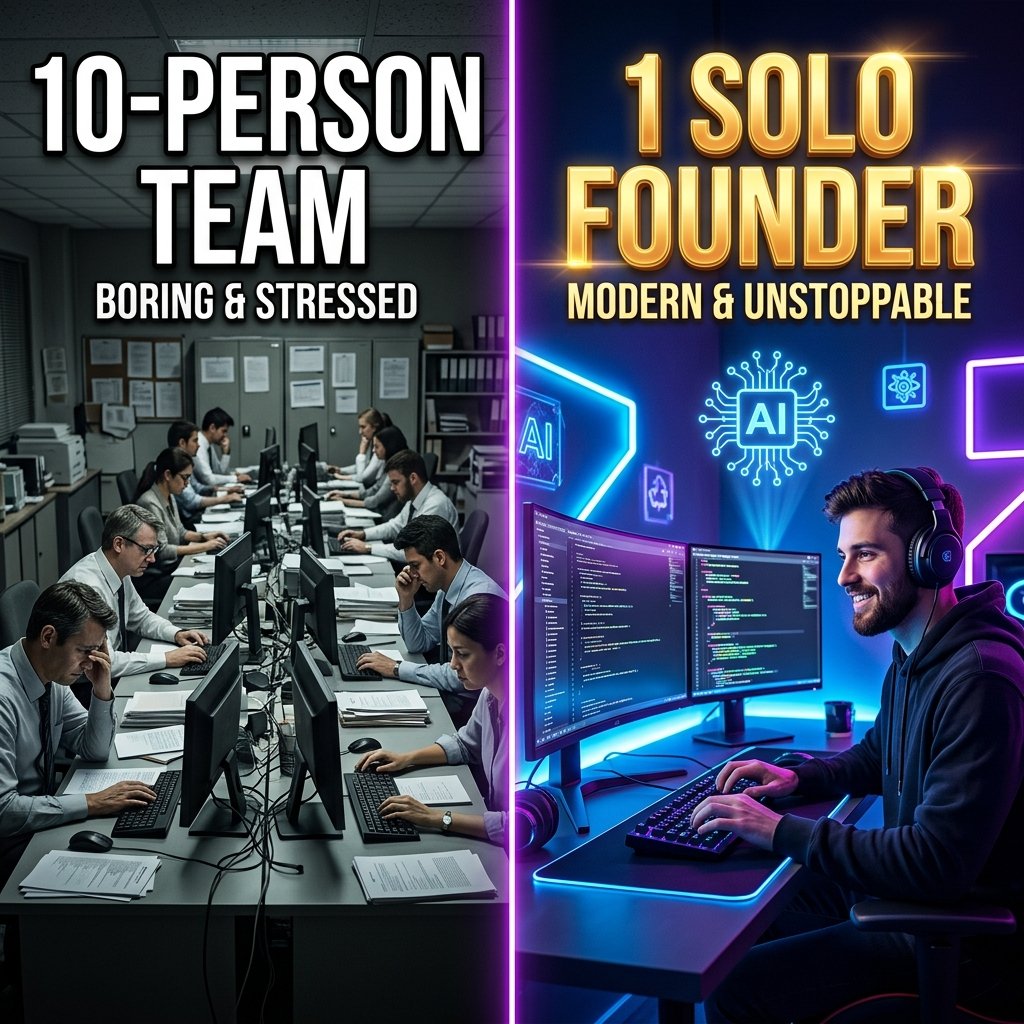
I was sitting in a high-end coffee shop in San Francisco last month, listening to a VC-backed founder complain about his payroll, when I had to bite my tongue to keep from laughing out loud.
This guy was stressed. He was running a ten-person software startup. He had just raised a million dollars in seed funding, and he was already burning through eighty thousand dollars a month.
He was complaining about developer turnover, customer support drama, and lease negotiations.
I looked at my laptop screen. On it was the dashboard of a simple micro-SaaS business I run entirely by myself.
My monthly overhead? About four hundred dollars. My monthly revenue? Twenty-two thousand dollars. My headcount? Exactly one. Me.
The traditional startup model is an absolute scam.
Every guru pitches the old playbook: raise money, rent a loft, and spend your days in useless management meetings.
It is an idiot idea. It is a slow, painful way to drown in overhead and human drama.
The era of the bloated ten-person startup is dead. The single operator is the new empire.
You do not hire employees anymore. You deploy stacks.
Here are the five AI tech stacks that will run every million-dollar solo-business this year.
1. The Autonomous Content Engine
Organic traffic is vital, but paying an agency five thousand dollars a month to write generic blog posts is a waste of cash.
The modern content stack is completely automated.
Here is how it works: you use Claude 3.5 Sonnet connected to Make.com and Framer.
First, you set up a visual database in Airtable with fifty niche topics your customers actually care about.
Second, Make triggers a daily workflow. It pulls one topic from Airtable and sends a multi-step prompt to Claude. The prompt instructs the AI to write a highly detailed, storytelling-driven, nine-hundred-word industry analysis.
Third, Make takes the output, cleans the HTML, and pushes it directly into your Framer website CMS via their REST API.
You do not write a word. A premium content engine runs 24/7 on autopilot, driving customers to your landing page for the cost of API pennies.
2. The Cold Outreach Machine
Cold email is the fastest way to get high-ticket clients, but manual personalization is a recipe for burnout.
The new outreach stack sends a thousand hyper-personalized, context-aware emails daily while you sleep.
The stack: Instantly.ai, Clay, and OpenAI.
First, you use Clay to scrape lists of target businesses from LinkedIn or Google Maps. Clay does not just scrape the name; it enriches the lead by visiting their website, pulling their recent social media updates, and identifying their primary tech tools.
Second, Make sends this rich data to the OpenAI API. GPT-4o reads the enrichment data and writes a highly personalized, two-sentence opening hook tailored specifically to that business.
Third, the personalized lead list is pushed directly to Instantly.ai, which sends the emails from ten different domain names to ensure perfect inbox deliverability.
It looks like a human spent thirty minutes researching. In reality, a visual workflow processed five hundred leads in two minutes.
3. The Customer Support Rep
Managing customer support emails and phone calls is the ultimate time-killer for solo founders. You cannot scale a business if you are spent answering basic questions about pricing or password resets all day.
The solution is not hiring a cheap assistant overseas. It is deploying a voice and text agent.
The stack: Retell AI, Vapi, and Make.
Retell AI and Vapi build custom AI voice agents that sound completely human. They sound like a professional customer service representative sitting in an office.
When a customer calls your support line, the AI answers, explains your product, and answers questions using a custom knowledge base. If the user wants to buy or schedule a sales consultation, the AI integrates with Cal.com to book the meeting and updates your CRM automatically.
No management. No payroll. Zero human error.
4. The Solo Developer
Building a software product used to require months of coding or spending fifty thousand dollars on a software agency.
Today, solo founders are building enterprise-grade SaaS tools in a weekend.
The stack: Cursor, v0.dev, and GitHub.
First, you go to v0.dev and describe the user interface you want. The AI instantly generates a stunning, responsive React frontend.
Second, you copy that code into Cursor, an AI-powered code editor. You highlight the code and tell the AI what backend database and APIs to build.
Third, you push the code to GitHub, and automated actions deploy your application directly to the web.
You are a CTO without knowing how to write database migrations. The software barrier to entry has hit zero.
5. The Financial Back-Office
Reconciling invoices, tracking expenses, and calculating tax is the most boring part of entrepreneurship. It is also the easiest to automate.
The stack: Airtable, Stripe, and Make.com.
When a customer pays you on Stripe, Make captures the transaction details. It automatically calculates the tax, generates a custom PDF invoice, emails it to the customer, and records the revenue in your master Airtable accounting sheet.
At the end of the month, a simple automation formats the data and emails it to your CPA.
No expensive bookkeeper. No spreadsheets. No human mistakes.
The Solo Founder Mandate
Stop building teams. Start building systems.
The entrepreneurs who win in the next five years will not be the ones with the most employees. They will be the ones who manage the most efficient AI systems.
The tools are sitting right in front of you. The templates are ready.
Are you going to keep managing payroll and human drama, or are you actually going to build a million-dollar system this weekend?